Green Part 6: Finally installing solar panels!
- Nik Ingle
- Oct 17, 2022
- 5 min read
Updated: Jun 3, 2025
With a good roof on the house, and a fully updated electrical system, we were finally set to install solar. Then we ran into COVID supply chain issues...
Getting hold of solar panels turned out to be fairly straightforward. Renvu is an amazing place for a DIY person to be able to purchase first tier solar panels at the same prices that large installers get access to. I was able to purchase panels for $0.59 per watt.
Getting hold of inverters proved more challenging, but I made it worse by wanting the latest and greatest micro-inverters from Enphase. The IQ-8 micro-inverters are really amazing, in that when separated from the grid they can form their own microgrid and respond instantaneously to the power needs of the house. Enphase calls this feature "Daylight backup"... you can generate power if the sun is out even if the grid is not present. I consider this a real breakthrough and have been very impressed with the entire Enphase product system (including their batteries, which also use the same inverter).
What really caused me some sleepless nights was trying to get hold of the appropriate circuit breakers! I ended up finding a few of the breakers I needed on eBay, of all places, because they were not only out of stock in stores, and at distributors, but no one had any idea when they would be in stock again. After many, many hours spent chasing them down, I did manage to get hold of everything I needed.
The plan (which I had figured out many months ago) was to balance the complications of installation with configuring the largest sized solar array possible, while making sure I got decent power throughout as much of the day as possible. Vanessa wouldn't let me mount solar panels directly onto the west face of the house (she didn't think they would look good as siding!) -- so we ended up with the following schematic setup:

I don't have a compass on here, but south is towards the bottom left corner. This means the main roof solar array is pointed South- South East, and the two panels over the rear door are pointed West-South West.
With 21 Hyundai 395W panels, the panels could theoretically generate 8.3kW of DC power. I chose to pair these panels with the IQ-8A inverters, which have a continuous output of 349VA, meaning that I could theoretically generate 7.3kW AC power. However, given not all my solar panels point in the same direction, the system maxes out at 6.5kW, but manages to collect power over more hours in a day. Predictions are that it will generate ~12.3MWhr per year. This should be enough to fully power the house and our car. The catch is that we will need a decent amount of that power when the sun is not shining. In a later blog post I will explain how we decided to tackle that problem!
To connect solar panels to a metal roof, S-5! has a number of different connectors that work remarkably well. I used the Corrubracket 100T-PV.

You set up all these brackets on the roof, and then just slide the panels into them and tighten the screw. Simple! Well, not quite that simple, because you have to keep everything straight and true. I had some very good help with this from my friend Naveen.

Our first row of Corrubrackets installed, and the first panel mounted... only 20 more to go!
Getting the solar panels onto the roof required a "contraption". This was my second attempt at getting solar panels on a roof (having already done this on Vanessa's mum's house), so this version of the "contraption" worked pretty well. We had a wooden sled that slid up a ladder. When it got to the top of the ladder the top wood structure clipped over the ladder to hold it in place. We could then slide the panel over that top piece of wood to get it all the way onto the roof.

Naveen was actually getting ready to take a picture here, not just playing with his phone! He did the heavy lifting of the panels as we brought them up onto the roof.
We got all the panels on the main roof installed in 2 days, with the IQ-8 micro-inverters installed and wired up.

Next came the two panels that act as a porch over the back door. The installation here was trickier, since I needed to find a way to mount the panels at the correct angle, and have them securely bolted into the framing of the building. That sounds trivial, but the solar panels need to be supported at certain locations and the framing of the building may, or may not, be cooperative... I ended up finding some great mounting brackets from Power Structures LLC in Grass Valley, and then mounted them about 6" higher than I initially planned so that I could bolt the support structure into the top plate of the wall framing. This allowed me to place them wherever the solar panels required them.
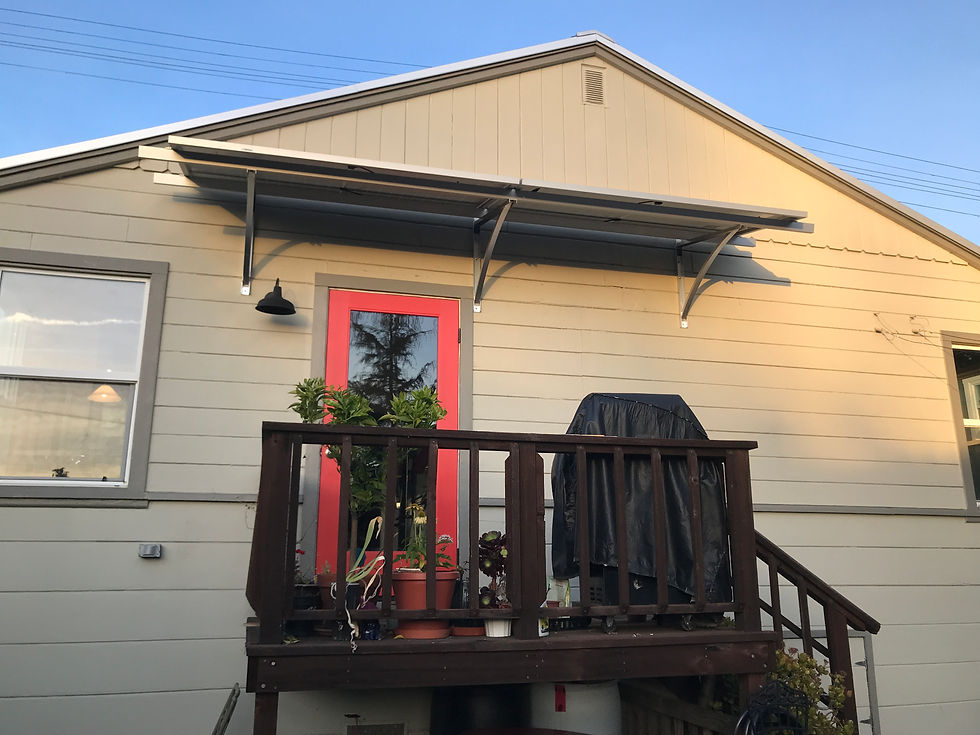
The placement worked out quite well. (I did eventually trim off the support struts.) There are plans to "remodel" the deck at some point in the future, and the placement of the panels and the door will make more sense when that happens.
The final part of the puzzle is connecting all of this to the house electrical system. Because I chose to use the IQ-8 micro-inverters in their "daylight backup" configuration, I needed to add an automatic grid disconnect switch. This switch will automatically disconnect the house from the grid if the grid goes down, and a sub-panel behind that switch holds all of the circuits we need to be active if the grid is out. This particular configuration also means that I am ready to easily add a battery to the solar system when we eventually have the money to do that.
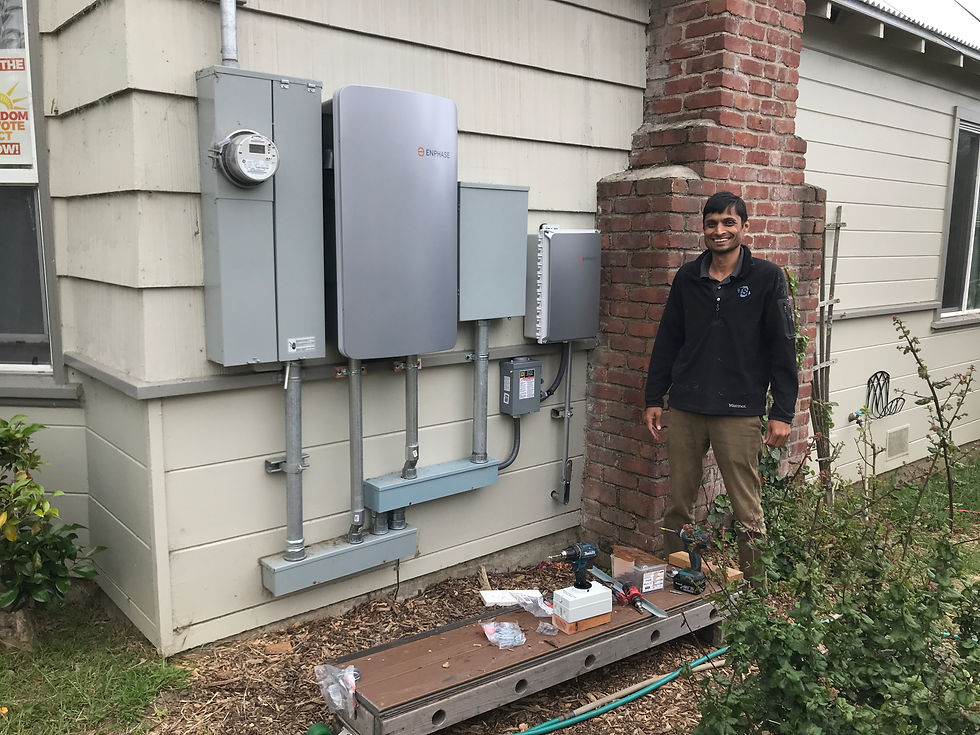
The panel on the left is the main house panel, where the grid connects. The second panel as you move to the right is the Enphase automatic switch that will disconnect the house from the grid if the grid goes down. The third panel is the sub panel that will be powered by the solar panels if the grid does down. In our case, all house circuits except the EV car charger and the induction stove are in the sub-panel. The final panel on the right is the Enphase combiner/communication box which is where all the solar panels connect into the system. There were a lot of connections and a lot of wires to get into the right place. It was a pretty major undertaking to include the Enphase automatic switch and sub-panel!
So far, we have generated about 1.4MWh/month, which is what we expected (and about 24 kWh of energy per day in mid-winter). Although the grid had gone down 4 times since we moved into the house, it has not gone down since the solar panels have been up... or maybe we didn't notice!
See also Green Part 7: Making full use of locally generated power, and Green Part 8: The Smartest HVAC on Earth.


Comments