What Makes Our Remodel “Green”? Part 1: Materials
- Vanessa Warheit & Nik Ingle
- Mar 8, 2021
- 3 min read
Updated: May 31, 2025
(After reading through my earlier posts, Nik pointed out that we hadn't actually mentioned how we were designing the remodel to be environmentally friendly and sustainable. So here is the first in a series of posts about the 'green' aspects of what we're doing.)
"Green" covers a lot of territory, so I figured it would be worthwhile pulling together some information on some of the different aspects of our renovation that we would consider green. (See here and here for additional aspects of our green remodel.)
Aspect #1: Waste and Re-Use. Careful deconstruction allows the reuse of lots of material. For example, all 2x4 lumber that we pulled out of the house during demolition was reused to frame in the new doors. When the rear porch was deconstructed to move the rear door over two feet, the wood underneath the shingles on the porch roof turned out to be the same wood as the house siding, so that wood was collected, de-nailed, and sorted, and ultimately used to help fill in the missing siding, once the door was moved.


The archway in the dining room was also built from re-used lumber.

We hired a local hauler to come take away the recyclable metal. But not everything can be reused, and the largest portion of our waste has been old sheetrock. (For that, we used YellowSack.com.)

Another large re-use project was the garden shed. This started out as a carport on the side of our detached garage, which had a fiberglass corrugated roof and was built from redwood lumber.
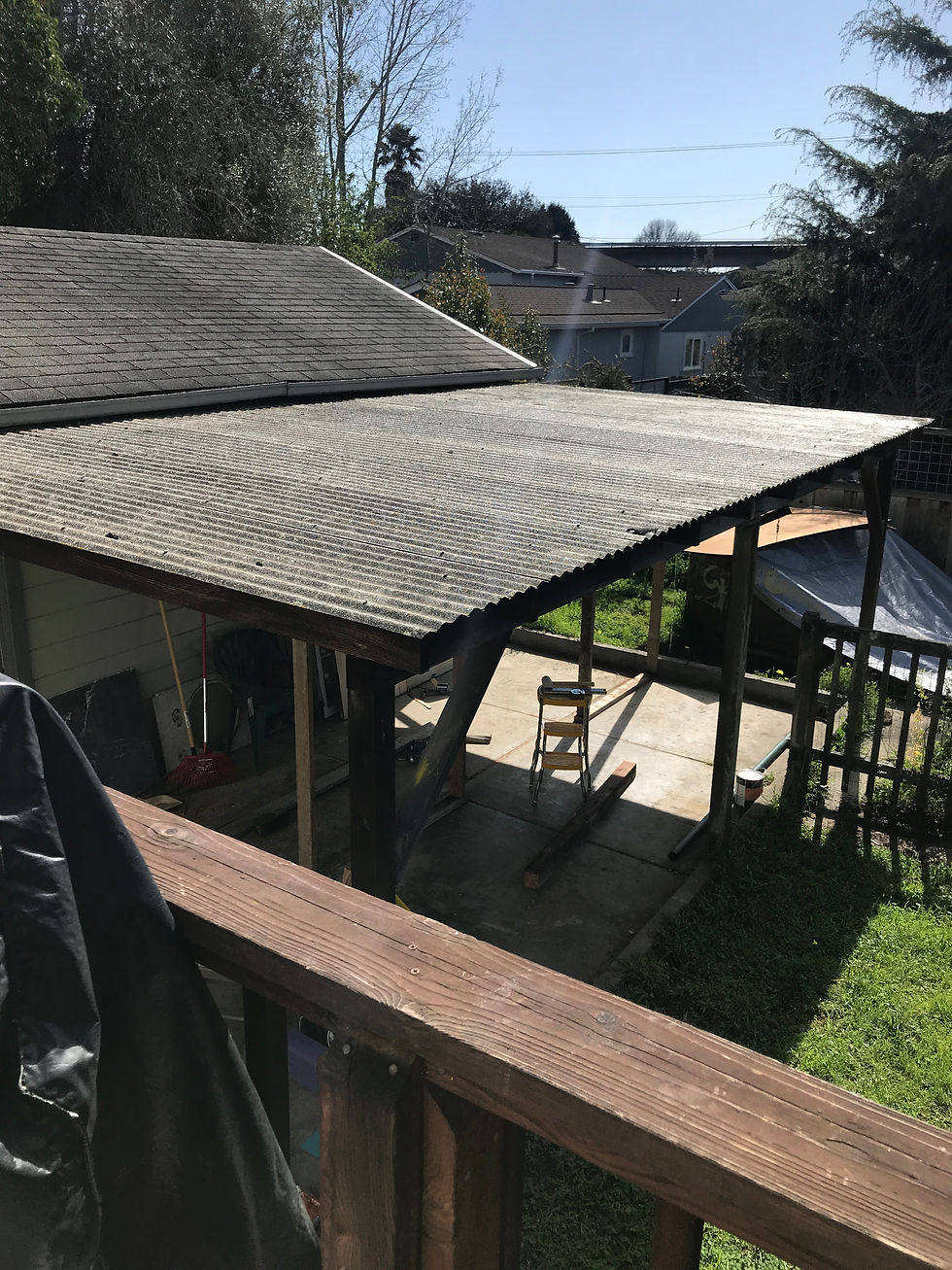
We cut down the size of the carport to transform it into a work shed. Everything to build the shed, except for the fasteners and door hardware, was reused - either from the house or the carport, or purchased from salvage yards (Urban Ore, the Reuse People, and Heritage Salvage).

I also used some of the corrugated fiberglass roofing to build the roof of a new shed to enclose our 120 gallon hot water tank, which acts as our overnight thermal storage for house heat & domestic hot water. (More on that in a future post!) The remainder will be used to roof our new bike sheds. The sheds will be integrated into a new fence and gate, which we are building using new lumber. (Because pressure treated lumber is now considered a hazardous waste, we are choosing to do all exterior wood construction from redwood and/or cedar.)

We are still trying to figure out what to do with all the concrete we plan to remove. I have read on the internet that it should be possible to make good use of old concrete -- either crushed as an under-layer for a permeable pathway/driveway, maybe used as paving stones, or as part of retaining walls.
Aspect #2: Materials. We have done everything we can to avoid purchasing anything for the house made from plastic (most specifically PVC). The only place we have used PVC is for the electrical wiring, where ROMEX cable is clad in PVC. There may be another option, but if there is I have not seen it.
Our flexible duct work for the HVAC system is a metallized plastic. The only other option would have been a flexible aluminum duct, but it has large ridges to make it flexible -- which turns out to be inefficient for our house fan, and therefore also noisy.

We have chosen low VOC paints, flooring, and underlayment materials, and used FSC wood sources (including for the few pieces of new construction lumber needed). We have also been very careful not to use any new foam as insulation in the house. Wall and crawl space insulation is rock-wool, attic insulation is cellulose, and I used a reclaimed piece of XPS foam as additional insulation under the hot water tank. (My plan had been to use cork for this, but this seemed like a better option than buying new materials.)
See also Part 2: Electrification and Part 3: Insulation and Gray Water


Comments